Note
Go to the end to download the full example code.
An article with equations#
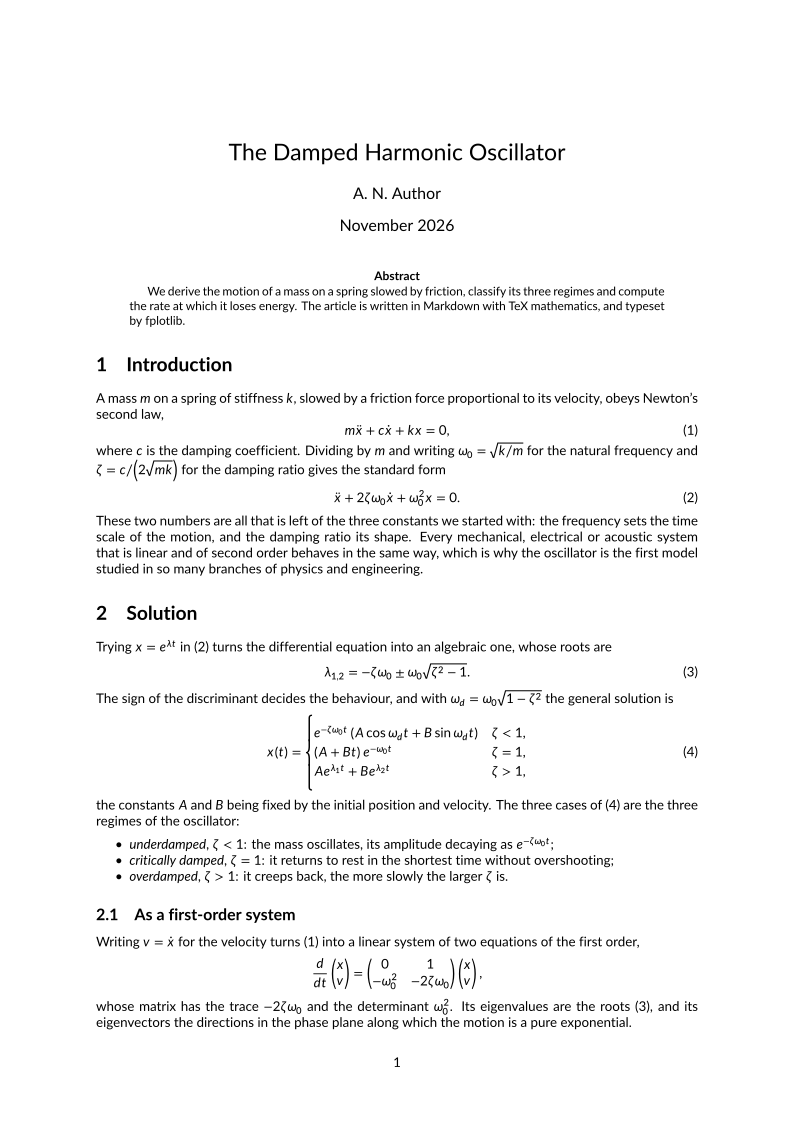
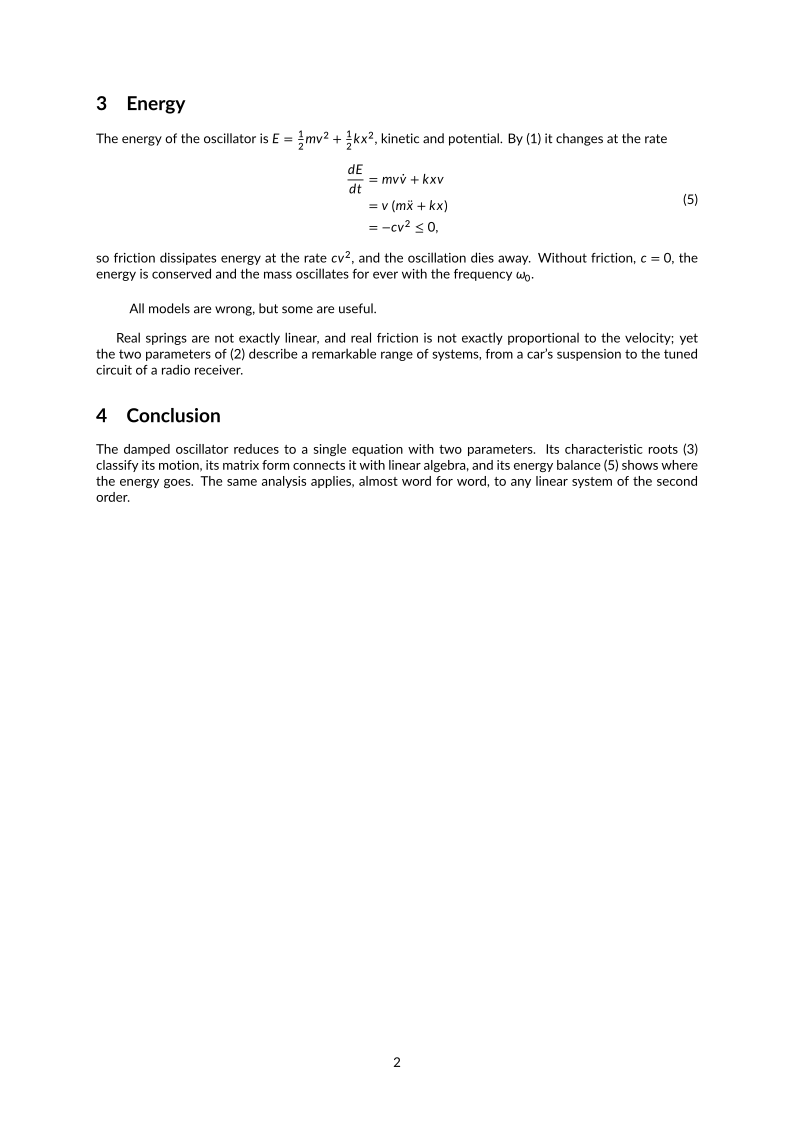
A short scientific article: a title block and an abstract from the front matter, numbered sections, displayed equations numbered and referred to by name, a case distinction, a matrix, an aligned derivation, a list and a quotation. It runs over two pages, cut where TeX’s page builder would cut them.
The text is a strict MyST subset and the mathematics is TeX’s.
$$ ... $$ (eq:name) labels and numbers a display, and the {eq} role
refers to it. Paragraphs are broken into lines as TeX breaks them, with the same
hyphenation, and the spacing around headings, lists and displays is
LaTeX’s article class.
The backslash in these strings is a real character. That is the default
for gfortran, flang and ifx. A compiler that treats \ as an escape
wants \\ in the literal.
program plot_article
    use fplotlib, only: typeset
    implicit none

    call typeset([character(len=100) :: &
        "---", &
        "title: The Damped Harmonic Oscillator", &
        "author: A. N. Author", &
        "date: November 2026", &
        "abstract: We derive the motion of a mass on a spring slowed by friction, classify its", &
        "  three regimes and compute the rate at which it loses energy. The article is written", &
        "  in Markdown with TeX mathematics, and typeset by fplotlib.", &
        "numbersections: true", &
        "---", &
        "", &
        "# Introduction", &
        "", &
        "A mass $m$ on a spring of stiffness $k$, slowed by a friction force proportional to", &
        "its velocity, obeys Newton’s second law,", &
        "$$ m\ddot{x} + c\dot{x} + kx = 0, $$ (eq:motion)", &
        "where $c$ is the damping coefficient. Dividing by $m$ and writing", &
        "$\omega_0 = \sqrt{k/m}$ for the natural frequency and $\zeta = c/(2\sqrt{mk})$ for the", &
        "damping ratio gives the standard form", &
        "$$ \ddot{x} + 2\zeta\omega_0\dot{x} + \omega_0^2 x = 0. $$ (eq:standard)", &
        "These two numbers are all that is left of the three constants we started with: the", &
        "frequency sets the time scale of the motion, and the damping ratio its shape. Every", &
        "mechanical, electrical or acoustic system that is linear and of second order behaves", &
        "in the same way, which is why the oscillator is the first model studied in so many", &
        "branches of physics and engineering.", &
        "", &
        "# Solution", &
        "", &
        "Trying $x = e^{\lambda t}$ in {eq}`eq:standard` turns the differential equation into an", &
        "algebraic one, whose roots are", &
        "$$ \lambda_{1,2} = -\zeta\omega_0 \pm \omega_0\sqrt{\zeta^2 - 1}. $$ (eq:roots)", &
        "The sign of the discriminant decides the behaviour, and with", &
        "$\omega_d = \omega_0\sqrt{1 - \zeta^2}$ the general solution is", &
        "$$ x(t) = \begin{cases} e^{-\zeta\omega_0 t}\left(A\cos\omega_d t + B\sin\omega_d t\right)", &
        "   & \zeta < 1, \\ (A + Bt)\,e^{-\omega_0 t} & \zeta = 1, \\", &
        "   A e^{\lambda_1 t} + B e^{\lambda_2 t} & \zeta > 1, \end{cases} $$ (eq:regimes)", &
        "the constants $A$ and $B$ being fixed by the initial position and velocity. The three", &
        "cases of {eq}`eq:regimes` are the three regimes of the oscillator:", &
        "", &
        "- *underdamped*, $\zeta < 1$: the mass oscillates, its amplitude decaying as", &
        "  $e^{-\zeta\omega_0 t}$;", &
        "- *critically damped*, $\zeta = 1$: it returns to rest in the shortest time without", &
        "  overshooting;", &
        "- *overdamped*, $\zeta > 1$: it creeps back, the more slowly the larger $\zeta$ is.", &
        "", &
        "## As a first-order system", &
        "", &
        "Writing $v = \dot{x}$ for the velocity turns {eq}`eq:motion` into a linear system of two", &
        "equations of the first order,", &
        "$$ \frac{d}{dt}\begin{pmatrix} x \\ v \end{pmatrix} = \begin{pmatrix} 0 & 1 \\", &
        "   -\omega_0^2 & -2\zeta\omega_0 \end{pmatrix} \begin{pmatrix} x \\ v \end{pmatrix}, $$", &
        "whose matrix has the trace $-2\zeta\omega_0$ and the determinant $\omega_0^2$. Its", &
        "eigenvalues are the roots {eq}`eq:roots`, and its eigenvectors the directions in the phase", &
        "plane along which the motion is a pure exponential.", &
        "", &
        "# Energy", &
        "", &
        "The energy of the oscillator is $E = \tfrac{1}{2}mv^2 + \tfrac{1}{2}kx^2$, kinetic and", &
        "potential. By {eq}`eq:motion` it changes at the rate", &
        "$$ \begin{aligned} \frac{dE}{dt} &= m v \dot{v} + k x v \\ &= v\,(m\ddot{x} + kx) \\", &
        "   &= -c v^2 \le 0, \end{aligned} $$ (eq:energy)", &
        "so friction dissipates energy at the rate $cv^2$, and the oscillation dies away. Without", &
        "friction, $c = 0$, the energy is conserved and the mass oscillates for ever with the", &
        "frequency $\omega_0$.", &
        "", &
        "> All models are wrong, but some are useful.", &
        "", &
        "Real springs are not exactly linear, and real friction is not exactly proportional to", &
        "the velocity; yet the two parameters of {eq}`eq:standard` describe a remarkable range of", &
        "systems, from a car’s suspension to the tuned circuit of a radio receiver.", &
        "", &
        "# Conclusion", &
        "", &
        "The damped oscillator reduces to a single equation with two parameters. Its", &
        "characteristic roots {eq}`eq:roots` classify its motion, its matrix form connects it with", &
        "linear algebra, and its energy balance {eq}`eq:energy` shows where the energy goes. The", &
        "same analysis applies, almost word for word, to any linear system of the second order."], &
        "article.svg")
end program plot_article
Total running time of the script: (0 minutes 0.040 seconds)