Note
Go to the end to download the full example code.
A book chapter#
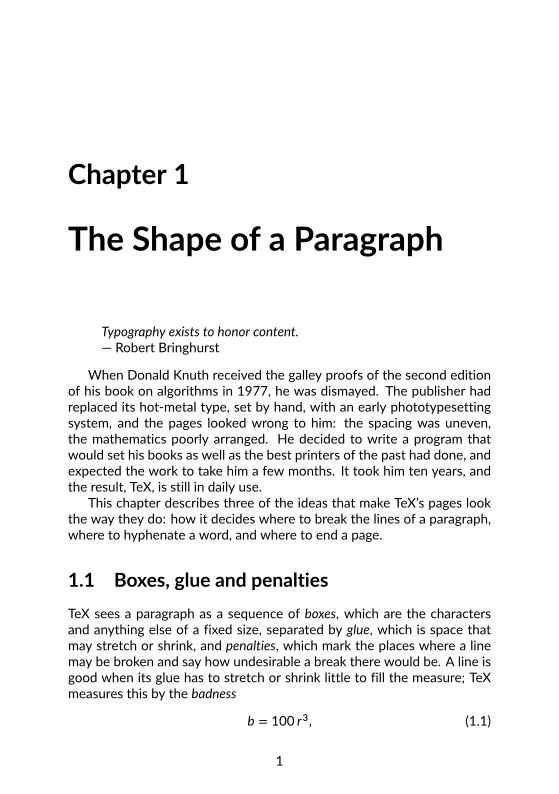
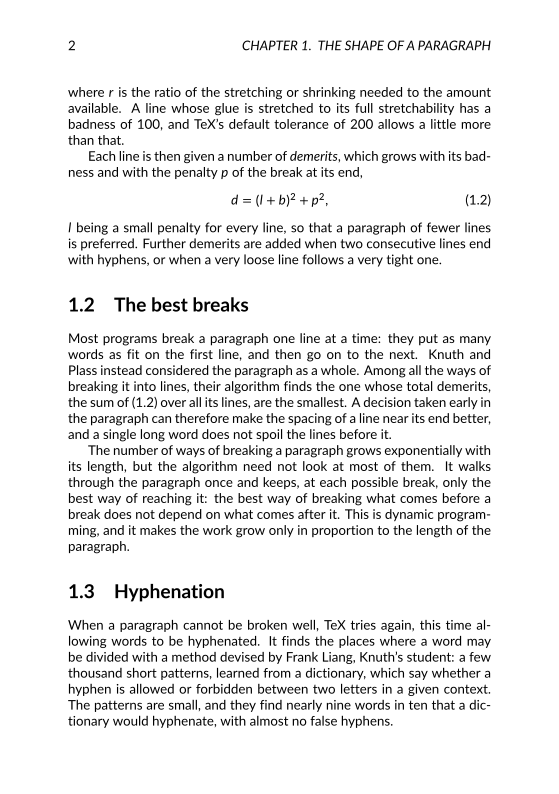
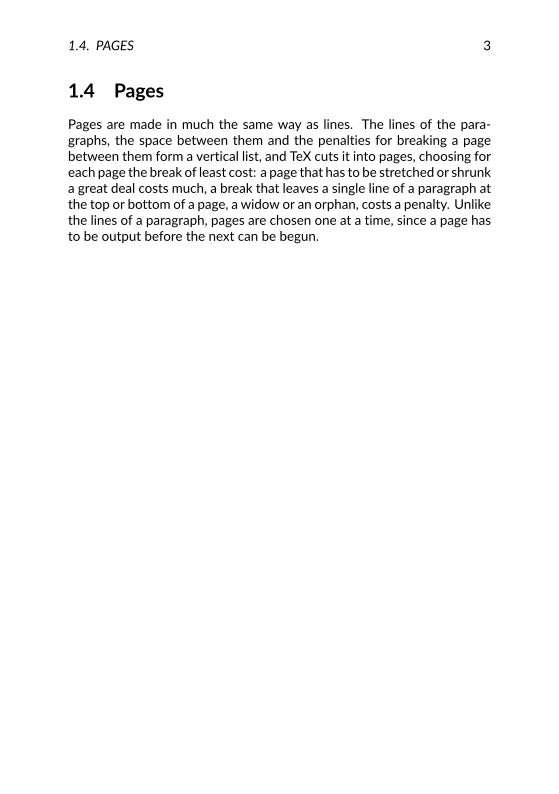
The opening of a chapter of a book, on A5 paper: LaTeX’s book class
sets the chapter heading on a new page, “Chapter 1” above the title,
numbers the sections and the equations within the chapter, and puts a
running head and the page number at the top of every page after the
first. Pages are filled to the bottom (\flushbottom) by stretching
the space between paragraphs, as a book’s pages are.
chapters: true, runningheads: true and flushbottom: true
configure the book layout, and the local book_heading callback sets
chapter openings and running heads.
program plot_book_chapter
    use fplotlib, only: dp, typeset
    use fplotlib_markdown, only: md_document_t, md_ctx_t, md_heading_t, md_inline, md_noindent, &
                                 md_base_size
    use fplotlib_typeset, only: ts_page_break, ts_mark, ts_vkeep, ts_begin_par, &
                                ts_end_par, ts_penalty, ts_vskip, ts_nobreak_next, &
                                ts_glue_t, ALIGN_LEFT
    implicit none

    call typeset([character(len=100) :: &
        "---", &
        "chapters: true", &
        "runningheads: true", &
        "flushbottom: true", &
        "paper: a5", &
        "fontsize: 10pt", &
        "margin: 1.8cm", &
        "margin-top: 2.2cm", &
        "numbersections: true", &
        "---", &
        "", &
        "# The Shape of a Paragraph", &
        "", &
        "> *Typography exists to honor content.*\ ", &
        "> --- Robert Bringhurst", &
        "", &
        "When Donald Knuth received the galley proofs of the second edition of his book on", &
        "algorithms in 1977, he was dismayed. The publisher had replaced its hot-metal type,", &
        "set by hand, with an early phototypesetting system, and the pages looked wrong to him:", &
        "the spacing was uneven, the mathematics poorly arranged. He decided to write a program", &
        "that would set his books as well as the best printers of the past had done, and", &
        "expected the work to take him a few months. It took him ten years, and the result,", &
        "TeX, is still in daily use.", &
        "", &
        "This chapter describes three of the ideas that make TeX’s pages look the way they do:", &
        "how it decides where to break the lines of a paragraph, where to hyphenate a word,", &
        "and where to end a page.", &
        "", &
        "## Boxes, glue and penalties", &
        "", &
        "TeX sees a paragraph as a sequence of *boxes*, which are the characters and anything", &
        "else of a fixed size, separated by *glue*, which is space that may stretch or shrink,", &
        "and *penalties*, which mark the places where a line may be broken and say how", &
        "undesirable a break there would be. A line is good when its glue has to stretch or", &
        "shrink little to fill the measure; TeX measures this by the *badness*", &
        "$$ b = 100\,r^3, $$ (eq:badness)", &
        "where $r$ is the ratio of the stretching or shrinking needed to the amount available.", &
        "A line whose glue is stretched to its full stretchability has a badness of 100, and", &
        "TeX’s default tolerance of 200 allows a little more than that.", &
        "", &
        "Each line is then given a number of *demerits*, which grows with its badness and with", &
        "the penalty $p$ of the break at its end,", &
        "$$ d = (l + b)^2 + p^2, $$ (eq:demerits)", &
        "$l$ being a small penalty for every line, so that a paragraph of fewer lines is", &
        "preferred. Further demerits are added when two consecutive lines end with hyphens, or", &
        "when a very loose line follows a very tight one.", &
        "", &
        "## The best breaks", &
        "", &
        "Most programs break a paragraph one line at a time: they put as many words as fit on", &
        "the first line, and then go on to the next. Knuth and Plass instead considered the", &
        "paragraph as a whole. Among all the ways of breaking it into lines, their algorithm", &
        "finds the one whose total demerits, the sum of {eq}`eq:demerits` over all its lines, are", &
        "the smallest. A decision taken early in the paragraph can therefore make the spacing", &
        "of a line near its end better, and a single long word does not spoil the lines before", &
        "it.", &
        "", &
        "The number of ways of breaking a paragraph grows exponentially with its length, but", &
        "the algorithm need not look at most of them. It walks through the paragraph once and", &
        "keeps, at each possible break, only the best way of reaching it: the best way of", &
        "breaking what comes before a break does not depend on what comes after it. This is", &
        "dynamic programming, and it makes the work grow only in proportion to the length of", &
        "the paragraph.", &
        "", &
        "## Hyphenation", &
        "", &
        "When a paragraph cannot be broken well, TeX tries again, this time allowing words to", &
        "be hyphenated. It finds the places where a word may be divided with a method devised", &
        "by Frank Liang, Knuth’s student: a few thousand short patterns, learned from a", &
        "dictionary, which say whether a hyphen is allowed or forbidden between two letters in", &
        "a given context. The patterns are small, and they find nearly nine words in ten that", &
        "a dictionary would hyphenate, with almost no false hyphens.", &
        "", &
        "## Pages", &
        "", &
        "Pages are made in much the same way as lines. The lines of the paragraphs, the space", &
        "between them and the penalties for breaking a page between them form a vertical list,", &
        "and TeX cuts it into pages, choosing for each page the break of least cost: a page", &
        "that has to be stretched or shrunk a great deal costs much, a break that leaves a", &
        "single line of a paragraph at the top or bottom of a page, a widow or an orphan, costs", &
        "a penalty. Unlike the lines of a paragraph, pages are chosen one at a time, since a", &
        "page has to be output before the next can be begun."], &
        "chapter.svg", on_heading=book_heading)

contains

    recursive subroutine book_heading(doc, h, ctx, handled)
        type(md_document_t), intent(inout) :: doc
        type(md_heading_t), intent(in) :: h
        type(md_ctx_t), intent(in) :: ctx
        logical, intent(inout) :: handled
        type(md_ctx_t) :: sub
        real(dp) :: b

        if (h%level == 2) then
            if (len(h%num) > 0) then
                call ts_mark(doc%engine, upcase(h%num//".  "//h%text), .false., section=.true.)
            else
                call ts_mark(doc%engine, upcase(h%text), .false., section=.true.)
            end if
            return
        end if
        if (h%level /= 1) return
        handled = .true.
        b = md_base_size(doc)
        call ts_page_break(doc%engine)
        if (len(h%num) > 0) then
            call ts_mark(doc%engine, upcase("Chapter "//h%num//".  "//h%text), .true.)
        else
            call ts_mark(doc%engine, upcase(h%text), .true.)
        end if
        call ts_vkeep(doc%engine, ts_glue_t(50.0_dp*b/10.0_dp, 0.0_dp, 0.0_dp, 0, 0))
        sub = ctx
        sub%bold = .true.
        if (len(h%num) > 0) then
            sub%size = 2.074_dp*b
            call ts_begin_par(doc%engine, ALIGN_LEFT, 0.0_dp, size=sub%size, &
                              leading=25.0_dp*b/10.0_dp, skip=.false., nobreak=.true.)
            call md_inline(doc, "Chapter "//h%num, sub)
            call ts_end_par(doc%engine)
            call ts_penalty(doc%engine, 10000)
            call ts_vskip(doc%engine, ts_glue_t(20.0_dp*b/10.0_dp, 0.0_dp, 0.0_dp, 0, 0))
        end if
        sub%size = 2.488_dp*b
        call ts_begin_par(doc%engine, ALIGN_LEFT, 0.0_dp, size=sub%size, &
                          leading=30.0_dp*b/10.0_dp, skip=.false., nobreak=.true.)
        call md_inline(doc, h%text, sub)
        call ts_end_par(doc%engine)
        call ts_penalty(doc%engine, 10000)
        call ts_vskip(doc%engine, ts_glue_t(40.0_dp*b/10.0_dp, 0.0_dp, 0.0_dp, 0, 0))
        call ts_nobreak_next(doc%engine)
        call md_noindent(doc, .true.)
    end subroutine book_heading

    function upcase(s) result(t)
        character(len=*), intent(in) :: s
        character(len=len(s)) :: t
        integer :: k, c
        t = s
        do k = 1, len(s)
            c = iachar(s(k:k))
            if (c >= iachar("a") .and. c <= iachar("z")) t(k:k) = achar(c - 32)
        end do
    end function upcase

end program plot_book_chapter
Total running time of the script: (0 minutes 0.050 seconds)